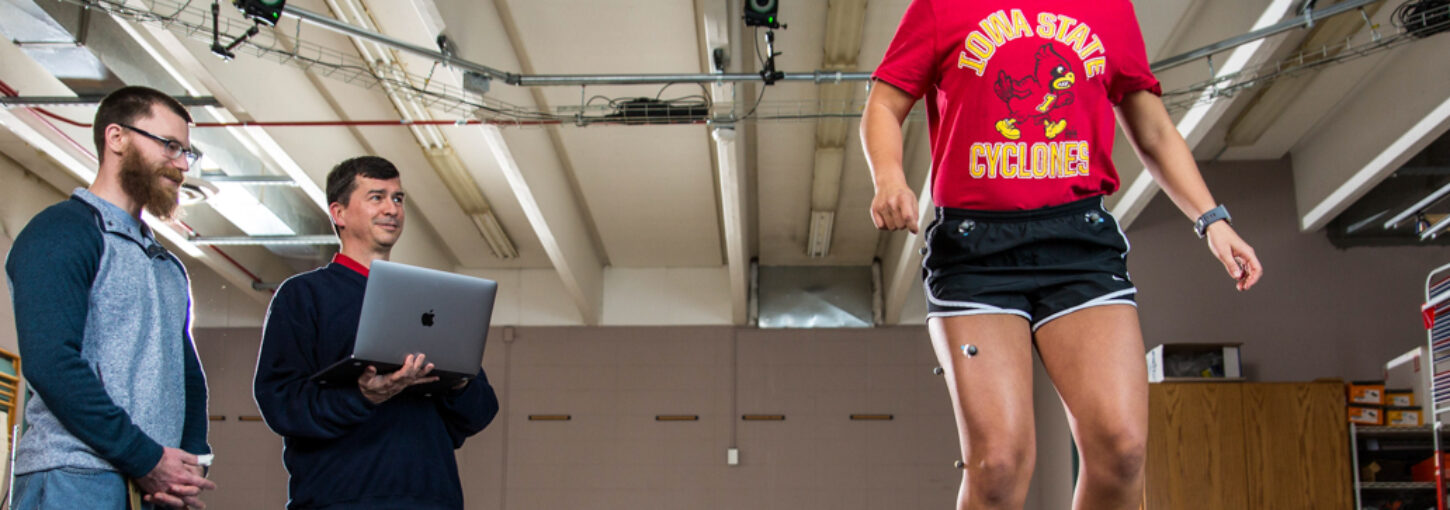
Biomechanics Research Lab

Location:  Room 178N Forker

Description

The Biomechanics Laboratory is a 1750 square foot facility that is part of the Human Performance Laboratories housed within the Department of Kinesiology and Health. The major pieces of laboratory equipment include:

  • Twelve 450 Hz, 6 megapixel Oqus 6+ cameras for rapid, high resolution 3D tracking ofretroreflective markers (Qualisys AB, Sweden)
  • Four 464 mm x 508 mm AMTI force platforms are positioned centrally on a 35-m walkway with a portable stair system (Advanced Mechanical Technology Inc., Watertown, MA)
  • Two 400 mm x 600 mm portable AMTI force platforms (Advanced Mechanical Technology Inc., Watertown, MA)
  • Eight channel wireless Delsys Trigno electromyography data collection system (Delsys, Natick, MA)
  • Opal Movement Monitoring System with two IMU sensors (APDM, Portland, OR)
  • XSENSOR wireless foot pressure mapping system (X4) with foot and gait software
  • Exeter Research Impact Tester for simulating walking and running impacts
  • Playground Clearinghouse head impact system for simulating falls onto various surfaces
  • Data logger (Biomedical Monitoring) used in conjunction with accelerometers as a portable data collection system capable of high-speed recording for extended periods of time
  • Vishay Instruments strain gauge measurement system for measuring principal strains are in bone
  • Software: SPSS, Matlab, OpenSim, Visual 3D, QTM data collection/motion analysis software (Qualisys), EMGworks data acquisition/analysis software (Delsys)

Research

Impact biomechanics (Dr. Tim Derrick)

The Biomechanics Laboratory has close ties with industry in the area of impacts. We have tested the cushioning properties of footwear for such organizations as Fila, Air Walk, Remington, Speedo, Wilson and the US Military. We have tested impact attenuation in gymnastics mats, vault tables and pads for companies such as Hadar Manufacturing and American Athletics. Shock attenuation has also been assessed in wheelchairs and basketball rims. Current research in this area involves the effects that the geometry of the body during the impact has on the effective mass and the impact attenuation.

Osteogenic exercise (Dr. Tim Derrick)

Older adults and astronauts during long duration spaceflight have decreased bone strength that can lead to fracture. Exercise has been shown to increase bone strength and could be used as a preventative measure if the boundaries of safe and effective use can be identified. We are using biochemical blood markers that are associated with bone resorption and formation in an effort to identify optimal patterns of impacts. We are also collecting impacts from various sport and exercise activities so that we can eventually identify those activities that produce the greatest osteogenic effect. The pattern of impacts can also play a role in stress fractures in athletes and military recruits. These are serious injuries that result in significant health care costs, lost training time, and interference with job performance and competition.

Assessment of back exoskeletons during patient handling (Dr. Jason Gillette)

The objective of this project is to determine if back exoskeletons are a potential intervention to reduce the risk of back injuries during patient handling. We are quantifying if low back exoskeletons reduce low back muscle activity and determining if healthcare workers perceive reduced exertion during patient handling compared to performing patient handling without assistance. In addition, we are compiling and interpreting healthcare worker opinions of back exoskeleton usability during patient handling.

Ergonomic needs and exoskeleton usage in manufacturing and construction (Dr. Jason Gillette)

The purpose of this research is to provide recommendations to manufacturing and construction companies by assessing back exoskeletons for tasks that require lifting and lowering movements and shoulder exoskeletons for tasks that require elevated arm movements. We identify job tasks where muscle fatigue and injury risk are a concern, then test exoskeletons either at a worksite or by simulating tasks in the Biomechanics Lab. Electromyography, video analysis, and questionnaires are utilized to estimate the risk of muscle fatigue, predict if an exoskeleton reduces this risk, and determine if an exoskeleton is a practical intervention for the job task.

Predictive modeling of shoulder fatigue and injury risk (Dr. Jason Gillette)

The purpose of this research is to create and validate a shoulder assessment model as an ergonomic application for objectively quantifying musculoskeletal disorder risk. This model maps arm postures with a range of hand loads to muscle activation levels. Shoulder muscle fatigue is predicted using the ACGIH fatigue threshold limit values. We utilize motion capture to provide accurate posture profiles of workers in both lab settings and real-world operations. This approach could improve the accuracy, repeatability, and efficiency of ergonomic assessments beyond typical observational methods.

Lower extremity foot function (Dr. Tim Derrick)

Foot disorders are difficult to study in humans because the foot is complex and resistant to internal examination. We have built a machine that allows us to move the muscles and skeleton of a cadaver foot in a natural motion so that we can measure bone movements and strains. We are working on using this information to build an accurate model of the foot so that function and dysfunction can be studied.

Collaborative Research

The Biomechanics Lab has collaborated on numerous projects with colleagues from industry, other disciplines, and other universities. For example:

  • Dr. Erin Ward of Central Iowa Foot Clinic to establish the kinematics of foot bones during human gait and to develop a gait simulator
  • The National Safety Council provided funding for the development of a predictive model for shoulder fatigue and injury risk.
  • The Center for Industrial Research and Service (CIRAS) at Iowa State University provided funding to assess back and shoulder exoskeletons for shelf stocking tasks in the construction industry.
  • The Heartland Center for Occupational Health and Safety at the University of Iowa provided training grant funding for the assessment of back exoskeletons during simulated patient handling.